
UK Fire Door Glass Regulations - Complete 2026 Compliance Guide
Strict fire door safety regulations are crucial in protecting lives by ensuring that fire doors are properly installed and maintained. These regulations, designed to prevent the rapid spread of fire, can be the difference between safe evacuation and catastrophe during a fire-related emergency.
Fire doors that contain glass have specific regulations which must be adhered to, on top of standard fire door regulations. This article will provide you with practical advice on navigating fire door glass ratings, understanding installation requirements, and following compliance tips to meet the latest 2025 standards.
DISCLAIMER: We have taken every care to ensure the accuracy of the information provided, but we cannot be held responsible for any loss or damage arising from its use. Please refer to official government guidance for the latest and most specific information.
What Are Fire Door Glass Regulations?
As mentioned earlier, fire doors must meet several regulations to be classed as effective and compliant - as explained in detail in our dedicated article. Following the events of the 2017 Grenfell Tower disaster in West London, the government has been under increased pressure to ensure that the regulations surrounding fire doors are as tight as possible.
Since many fire doors contain a vision panel made of glass, an emphasis has been placed on regulating the vision panels used in fire doors. Fire-resistant glass is a form of passive fire protection (PFP) - structural measures designed to prevent the spread of fire. Small fire-resistant glass windows are accepted in a wood or steel fire door, as long as they have been given an appropriate fire door glass rating (explained later).
The Role of Approved Document B
Approved Document B is a key part of the UK building regulations that set out the fire safety standards for buildings, including detailed guidance on the use and installation of fire door glass.
For fire door assemblies, Approved Document B specifies the required performance standards for glazing used in these doors; ensuring that the glass can withstand fire for a prescribed period. Here’s an extract from Document B Volume 1:
“Glazing in areas of fire resisting construction should be fixed shut and fire resisting (in terms of integrity, but not insulation) (minimum E 30).”
It is also noted that fire doors should contain vision panels in both of the following scenarios; a) where doors on escape routes divide corridors, and b) where doors are hung to swing both ways.
The regulations under Approved Document B apply across a wide range of property types, including:
- Residential Properties: Homes, flats, and multi-occupancy buildings.
- Commercial Buildings: Offices, shops, warehouses, and retail units.
- Public and High-Risk Buildings: Schools, hospitals, care homes, and other facilities where a higher level of fire safety is critical.
What Are the Benefits of Fire Doors With Glass

Fire doors with glass offer a combination of safety and design benefits:
- Glass panels allow more light into spaces, creating brighter, more welcoming environments.
- They add a modern, attractive element that can improve the overall design of a building, compared to standard non-glazed fire doors.
- Glass in fire doors can help occupants identify escape routes quickly during an emergency.
- They blend easily with both commercial and residential interiors while ensuring compliance with fire safety regulations.
Fire Door Glass Regulations for Existing Buildings vs New Builds
Existing buildings follow a different set of legislation compared to new builds:
- New buildings (or those undergoing changes such as extensions and alterations) are required to follow Approved Document B, meaning they must be certified to BS EN 12150 and tested per BS EN 1634.
- Existing Buildings (non-domestic properties) should follow The Regulatory Reform (Fire Safety) Order 2005, requiring regular checks and maintenance.
Although no specific fire safety legislation governs privately owned homes, landlords of rented properties must follow established rules. For example, in 2022, new legislation under the Fire Safety (England) Regulations 2022 was introduced for building owners or managers, which applies to any building containing two or more domestic dwellings (including mixed-use properties).
Understanding Fire Door Glass Ratings
Fire door ratings, also known as “fire door resistance ratings”, indicate the length of time a form of PFP (like a fire door) is expected to perform in the event of a fire. These ratings are commonly expressed as FD30, FD60, FD90, or FD120; each number representing the minimum duration (in minutes) during which the element will maintain its performance in a fire.
The glazing for vision panels on a fire door follows a very similar rating system, determined by BS EN 12150. This rating system, known as “E ratings”, is the European fire rating classification for the glazing in fire doors and partition walls, with the “E” representing the structural integrity of the door, and the corresponding number describing how long it should maintain integrity (preventing the spread of fire). For example:
- E30 provides integrity against fire for 30 minutes.
- E60 provides integrity against fire for 60 minutes.
- E90 provides integrity against fire for 90 minutes.
- E120 provides integrity against fire for 120 minutes.
These classifications can also specify:
- Integrity and insulation through “EI ratings”. For example, glazing which provides integrity and insulation for 30 minutes would be considered “EI30”.
- Integrity, insulation, and protection against radiant heat through “EW ratings”. For example, a product classified as “EW60” ensures integrity, insulation, and radiation protection for 60 minutes.
Installation Requirements for Fire Door Glazing
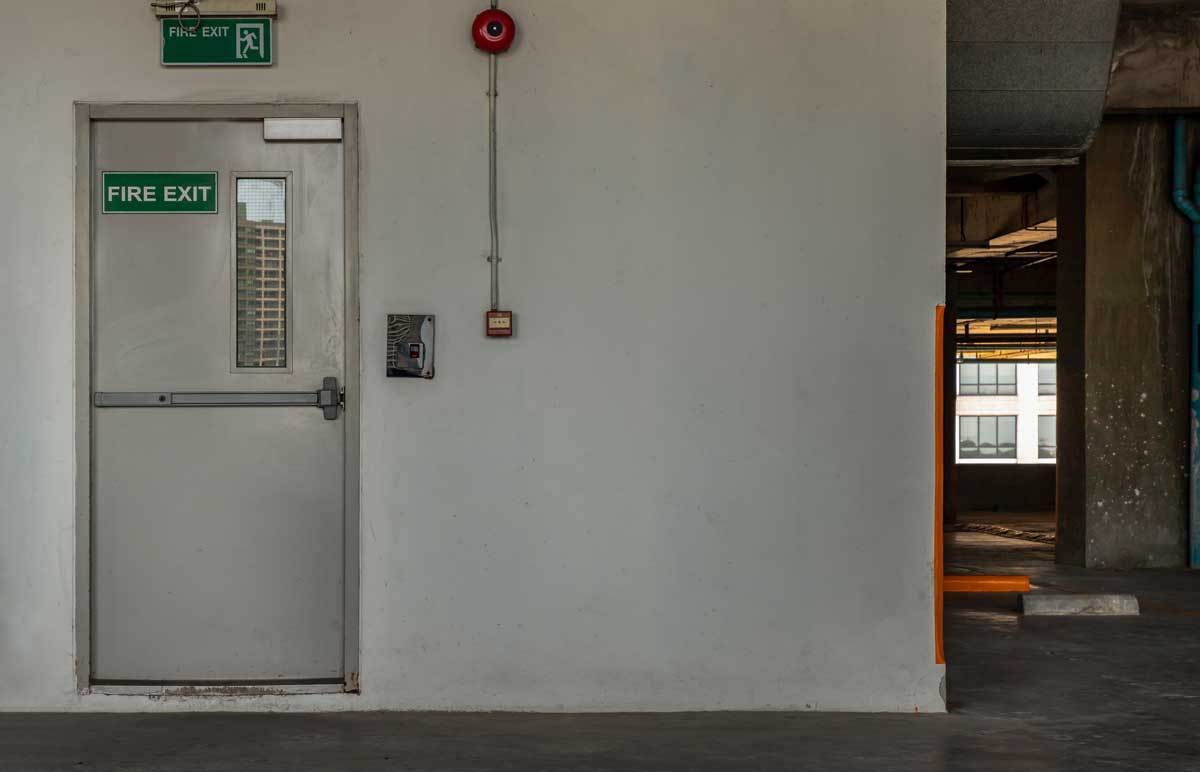
Approved glazing methods, proper seals, compatible door frames, and matching hardware are all important for ensuring that glass fire doors maintain their rated performance in the event of a fire. Let’s take a closer look at what is involved in each:
Glazing Systems
Only certified fire-resistant glass (e.g. embedded wired, tempered/toughened, laminated with fire-resisting interlayers, or ceramic/borosilicate) should be used. These must have a minimum glazed fire rating of E30.
Seals
The seals used on fire doors must be compatible with other system components, such as the glazed vision panel. There are a variety of acceptable seals which can be used, such as preformed channels to wrap around the glass edge, or gunable mastic compounds.
Beads & Fixings
The right beads and fixings are essential for securely holding the fire glass in place throughout the required duration. Particular attention should be paid to the glass edge cover, the angle of fixings, and the bead material, size, and shape.
Door Frames
In residential settings, glazed fire door frames are most commonly made from timber. These frames must be constructed to support and complement the door leaf and glazing components, with proper fire-stopping to seal gaps.
Door Leafs
The door leaf used for fire door glazing must be made from a solid core material which is specifically tested and approved for use with fire-resistant glass. It should have the necessary fire rating and be designed to accommodate the glazing system without compromising its integrity.
Hardware
All hinges, closers, latches, and other ironmongery present on a fire door must be specifically rated and certified for fire door use to ensure the full assembly meets fire resistance standards. Self-closing devices are often present on fire doors to create an automatic seal in the event of a fire.
Maintenance Requirements for Fire Door Glazing
Equally important for fire safety, the ongoing maintenance and inspection regime required by law ensures these systems remain fully effective throughout their lifespan. Proper, regular inspections of fire doors should be conducted by “responsible persons” (such as a firm of managing agents), where the following is assessed:
- Visual Inspections: Check for any physical damage, such as cracks, dents, or warping, and signs of deterioration in seals or hardware. Assess if there are any visible gaps around the door’s edge when it is shut.
- Functional Tests: Verify that self-closing devices are operating properly, that the door latches securely, and that any glazing remains intact. Fire doors should never be locked, and they should not be obstructed in any way, so this will also need to be checked.
Compliance Steps for Property Owners & Businesses
During the construction of a new property (or the refurbishment of an existing structure), there are several steps to keep in mind when installing fire doors. These often include:
- Conduct a Fire Risk Assessment: Evaluate the building’s hazards, identify escape routes, and determine the necessary fire door specifications.
- Partner with Accredited Suppliers and Installers: Use certified fire-resistant glass and door assemblies from reputable suppliers, and ensure professional installation by trained teams.
- Perform Regular Inspections: Schedule routine inspections of fire doors and their installed glazing to check for any damage or non-compliance with fire safety standards.
- Stay Updated on Regulations: Regularly review new updates to regulations to ensure that both installation and ongoing maintenance practices meet the latest fire safety requirements.
Useful Resources
- BWF Fire Door Alliance - Fire Door Glazing Fact Sheet
- Glass and Glazing Federation - Guide to Fire-Resistant Glazed Systems
- HM Government - Building Regulations 2010 Approved Document B
For Legally Compliant Fire Door & Glazing Wrap, Choose Complete Graphics

Just because fire doors are functional, they don’t have to be boring. At Complete Graphics, we specialise in glass manifestation and architectural wrapping for elements such as fire doors, adding visual interest to your interiors whilst staying compliant with UK fire door regulations.
To better understand your needs, please contact us to arrange a FREE, no-obligation consultation, either by phone at 01993 684112 or through our digital contact form.
Latest Posts
-
 Architecture Exhibitions & Trade Shows Guide 2026
 -
 UK Fire Door Glass Regulations - Complete 2026 Compliance Guide
 -
 Hotel & Hospitality Trade Shows in 2025-2026
 -
 How to Transform Staff Spaces With Vinyl Wrapping
 -
 How Vinyl Wrapping Your Hotel Saves You Money
 -
 Top 7 Benefits of Architectural Wrapping
 -
 Fire Door Safety Week 2024 (23rd-27th September)
 -
 What Is Commercial Interior Design?
 -
 How to Refurbish Your Office With Vinyl Wrap
 -
 Fire Door Regulations [2026]


