
Fire Door Regulations [2026]
Fire doors are a building’s first line of defence in a fire - designed to slow the spread of flames, heat, smoke, and toxic gases so people can quickly escape and firefighters can operate. Getting them right matters: a correctly specified, installed and maintained fire door protects lives, limits property damage, and keeps your building compliant with the Fire Safety (England) Regulations 2022.
Since the Grenfell Tower tragedy back in 2019, the importance of fire door performance and inspections has become even more prevalent. Surveys after the incident found doors that were damaged or altered, and which therefore failed to stop smoke and gases from spreading. That experience - and subsequent regulation - makes it essential that the person responsible for fire door safety understands what to check, how often inspections must happen, and what to do when a door is damaged or refurbished.
In this article, we will cover:
- What Is a Fire Door?
- Where Should Fire Doors Be Installed?
- What Are the Fire Door Regulations?
- What Is the Lifespan of a Fire Door?
- What Should a Fire Door Inspection Involve?
- How Often Does a Fire Door Need to Be Inspected?
- Who Is Responsible for Fire Door Inspections?
- What Are the Risks of Non-Compliance?
- What Are the Advantages of Vinyl-Wrapping Fire Doors?
What Is a Fire Door?
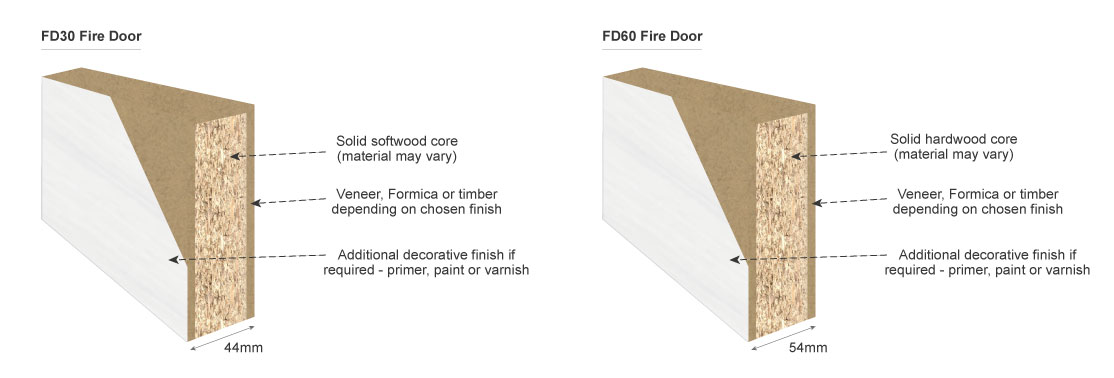
An internal fire door is a specialised door that is designed to resist the spread of fire and smoke within a building, as well as provide a clear route for escape. They are generally rated at a grade of FD30 and FD60 and are tested to withstand fire for a certain duration of time. An FD30-graded door can withstand a fire for up to 30 minutes; an FD60 door can withstand for 60 minutes.
FD30 fire doors are 45mm thick and are used for low-rise residential buildings and offices.
FD60 fire doors have a thickness of 54mm and are installed for high-rise and commercial buildings. If a building is fitted with this grade, it is usually designed to protect the building’s assets as well as the people.
Where Should Fire Doors Be Installed?
For a commercial building, the fire doors should be placed to allow for either a vertical or horizontal escape route within the building. A vertical escape route is usually the most common way to exit a building in the event of an emergency, for example, using the stairs to get everyone down to the ground and out swiftly. A horizontal escape route directs people to a space within a floor that is fireproof, and in this case, the route must be lined with fire doors.
With domestic buildings that are above two levels, every door that leads to the stairwell must be a fire door, where the door leads to a habitable room. Any rooms that have been converted into a loft must also be installed with fire doors.
For more information on fire resistance in properties, refer to Approved Document B, page 131, for building regulations in various purpose groups.
What Are the Fire Door Regulations?
Fire doors are crucial for intercepting fire and smoke in buildings. From January 2023, the Fire Safety Regulations 2022 concluded that the new fire door regulations must go through “quarterly checks” for all multi-occupied residential buildings over 11 metres in height. These preventative measures can be lifesaving because regular maintenance will help stop the risk of a fire from spreading.
Landlords are legally required to comply with the Regulatory Reform (Fire Safety) Order 2005 (FSO) for residential properties. This duty covers all fire protection measures for blocks of flats and other domestic dwellings, including the regulations governing fire doors.
It is required that fire doors be built with the following:
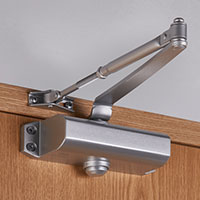
- Automatic door closers
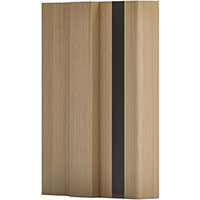
- Fire-resistant hinges
- Intumescent strips
- Smoke seals
Different elements of regulations must be complied with when it comes to installing a fire door, including:
|
Fire door signs
|
Green and white fire exit signs must be used to direct the person(s) following the escape route. They must be used along the evacuation route, but not specifically on doors. A blue and white “Fire Door Keep Shut” sign must be placed on both sides of the door. |
| Fire door height | There are currently no specific height restrictions for fire doors; instead, they should be measured by width, depending on the building size and capacity. |
| Retainer regulations | Fire doors must always remain shut, as doors are designed to close for safety measures. However, if it is fitted with an electromagnetic fire door, it can be left open and will automatically close when a fire is detected. |
|
Vision Panel
|
Small (fire-resistant) glass windows are acceptable in a wooden or steel fire door, as long as it is approved as fire safe. These glazed panels must provide the same fire-resistance performance as the door itself, typically classified as EW30 or EW60. |
| Gap Width | There must be a gap between the door and frames, which needs to be between 2mm and 4mm to block any smoke or gases from intruding. |
|
Frame
|
A fire door will often be installed with a frame, but it must be certified fire-resistant. |
|
Lock
|
Fire doors should never be locked if a building is in use, because they can block a person’s escape route. Any hinge or lock must pass the regulations. |
|
Hinge
|
Hinges on fire doors must be fire-resistant and work properly in order to open and close effectively. |
|
Fitting regulations |
Fire doors must be installed by a qualified Fire Door Inspection Scheme professional. The regulation checks should take place once every six months. |


What Is the Lifespan of a Fire Door?
As long as the fire door is regularly maintained, a typical lifespan is 10-15 years. However, knowing when to replace a fire door is critically important, as if it is not compliant, people’s lives are at risk. Fire doors can become worn due to:
- Forceful damage unrelated to a fire emergency
- Wear and tear
- Fire damage
What Should a Fire Door Inspection Involve?
According to a gov.uk report, the Fire Safety Act 2021 states that an accountable person for fire doors must consider:
- If there have been any alterations or damage to the door’s glazing apertures
- If there are any gaps around the door frame, and the seals and hinges are fitted correctly
- If objects or clutter are blocking the door
- The door closer shuts the door
- The door closes correctly around the whole frame
- There is no visible damage to the door and door closer
If the following has been noticed, then a fire door replacement will almost certainly be in order:
- Difficulty with closing the door or keeping it fully closed
- Visible gaps of more than 4mm around the door’s edge when it is shut
- Not being able to open and close the door with ease
- The door looks damaged and worn
- The glass panels have cracked
You can find more detailed information on fire door maintenance in this download from the UK Government website.
How Often Does a Fire Door Need to Be Inspected?
Regulation 10 of the Fire Safety (England) Regulations 2022 made it a legal requirement for all multi-occupied, multi-storey residential buildings in England (over 11 metres in height) to:
- Undertake quarterly checks (every 3 months) of all fire doors (including self-closing devices) in the common parts
- Undertake – on a best endeavour basis – annual checks of all flat entrance doors (including self-closing devices) that lead onto a building’s common parts
Who Is Responsible for Fire Door Inspections?
The legislation states that "responsible persons" are responsible for maintaining, inspecting and assessing the suitability of a fire door to perform its purpose, but that raises the question - who is classified as a "responsible person"?
Confusingly, the term is a bit of a misnomer, as explained in this guidance on the UK Government website:
"Sometimes, confusion arises from the term “Person”, because it might be expected that the “Responsible Person” is an individual living person (or what, in law, is described as a “natural person”). However, commonly, the Responsible Person will be an organisation, such as a property company or firm of managing agents (or what, in law, is described as a “legal person”)."
It also says:
"For all practical purposes, in the case of a block of flats, the Responsible Person will be the person who has control of the premises in connection with carrying on a business. This will, typically, be the freeholder or the managing agents for the block, or, for example, a residents’ management company."
However, as with all legal considerations, we would recommend you review the full documentation and seek legal advice if you are unsure.
What Are the Risks of Non-Compliance?
Non-compliance with fire door regulations can lead to huge fines, prosecution, voided insurance, costly emergency repairs, and - most importantly - avoidable injury or loss of life.
In 2022, a rental property in Bedford was found to have fire doors in a state of disrepair, and the property’s fire risk assessment hadn’t been reviewed since 2015. The landlord was subsequently fined £40,000 for their negligence.
What Are the Advantages of Vinyl-Wrapping Fire Doors?
Vinyl wrapping fire doors will not make a door that doesn’t meet fire safety regulation standards compliant. However, a vinyl-wrapped fire door has the following benefits:
- Gives an added level of protection from fire
- Heat-resistant up to 150 degrees centigrade
- Matches the building’s decorative aesthetic, making it appealing for offices, hotels, retail spaces, and other hospitality buildings
- Suitable for various materials, such as wood or steel
- Complies with fire safety regulations
Vinyl Wrap Your Fire Doors for Added Protection
Although fire doors are essential safety features, they don’t need to look unattractive. Our fire-resistant wraps add an extra layer of protection if a fire breaks out, and are designed to match the rest of your property’s aesthetics.
For more information about how we can help you, please get in touch with our team today to schedule a FREE consultation. Our friendly team will be more than happy to address any questions you may have!
Latest Posts
-
 Architecture Exhibitions & Trade Shows Guide 2026
 -
 UK Fire Door Glass Regulations - Complete 2026 Compliance Guide
 -
 Hotel & Hospitality Trade Shows in 2025-2026
 -
 How to Transform Staff Spaces With Vinyl Wrapping
 -
 How Vinyl Wrapping Your Hotel Saves You Money
 -
 Top 7 Benefits of Architectural Wrapping
 -
 Fire Door Safety Week 2024 (23rd-27th September)
 -
 What Is Commercial Interior Design?
 -
 How to Refurbish Your Office With Vinyl Wrap
 -
 Fire Door Regulations [2026]


